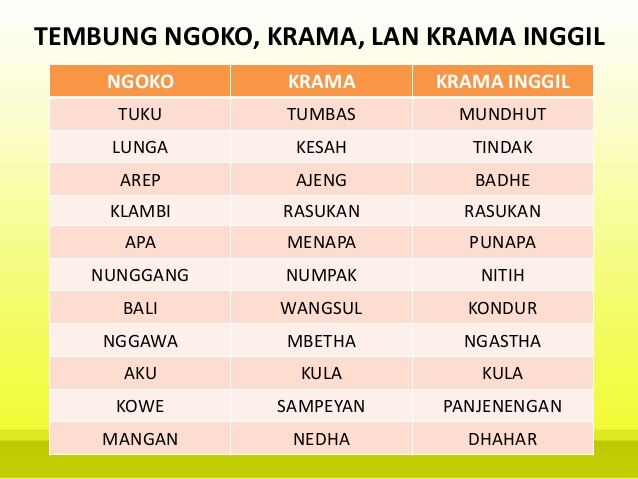
As Sahabat Javanologi aware of, Javanese culture is known with its unggah ungguh or its manner. Apart from attitudes towards others, it turns out that manners in Javanese culture can also be reflected in terms of the language spoken. The reflection of manners in this language can be found when Sahabat Javanologi have a company who is seen as older or more respectful. This is done to respect our company who has a higher degree than ourselves.
Javanese language has its own politeness values, starting from ngoko innocent, ngoko alus, krama lugu, dan krama inggil. The use this manner or unggah ungguh in Javanese shows respect for others. For example, when we talk to peers, we can use ngoko language or everyday language which is relaxed in nature, but when we talk to older people we should use polite Javanese like krama inggil to respect that person. The use of krama inggil is usually indicated by the vocabulary of the krama language used as a whole.
According to the Indonesian Dictionary or KBBI, Javanese krama inggil is the highest level in the communication system in the Java. As previously explained, the krama inggil language has the highest level of politeness among other Javanese languages. Specifically, krama inggil tend to used when we engaged or in a conversation with more respected person. For example, in the use of personal pronouns such as me, you, and them, in krama language they will become kula, njenengan, and piyambak. In addition, verbs can also be changed into krama language, for example, eating, writing, and sleeping into dhahar, nyerat, and sare.