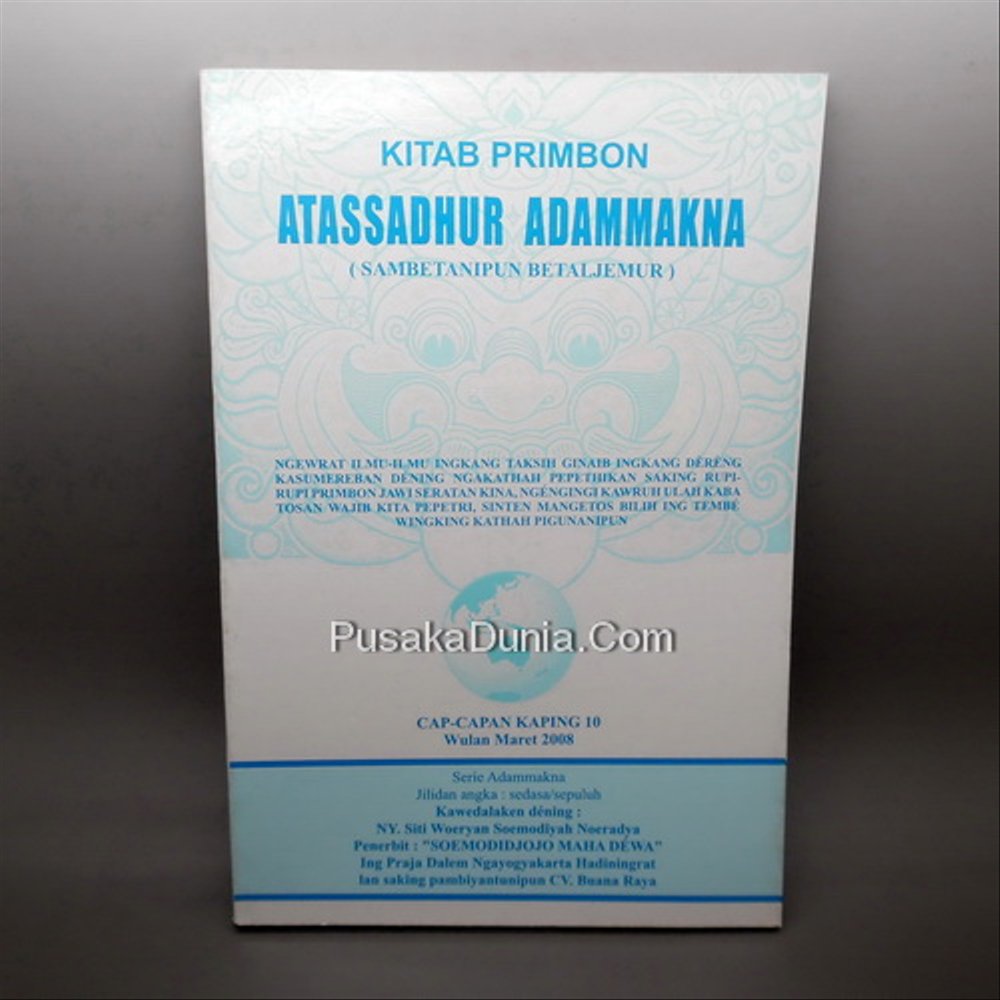
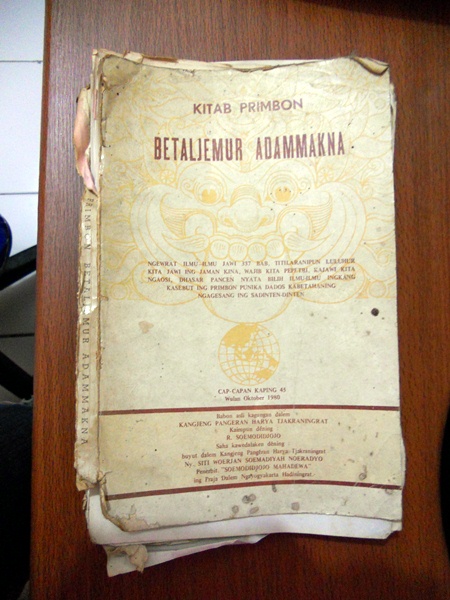
Javanese culture has long been considered as a developed culture especially in terms of philosophy. One thing in the spectrum of Javanese philosophy which is very well-known is primbon. If society in general (world’s citizens) has “zodiac system” in their astrology, and Chinese people have their shio, then Javanese people also have their own astrology system called primbon. Basically, primbon is a forecast system based on weton calculation and is usually used to predict and anticipate almost everything in a human’s life on a daily basis such as behavior, characteristic, romantic mate, spatial layout, directions, days, and many more. According to KBBI, primbon is defined as a Book consisting of forecast, knowledge of kejawen, occultism, a peculiar numeric system for calculating lucky days, and every other important matter.
Considering primbon as an ancestral heritage culture, the close proximity of Javanese people with primbon is an attempt to preserve its culture. Essentially, primbon, which is a book of ancestral inheritance, mainly oriented towards the relationship between mankind and nature and is used as a life guide for Javanese people.
The existence primbon as well as its birth and development are closely related to the influence of Islam in the archipelago, especially Java Island, where many Islamic values were adopted and acculturated with elements of Hinduism and Buddhism. At first, primbon was only a personal record that was passed down from generation to generation in the palace environment. Then when entering the 20th century, the Primbon manuscripts began to be printed and published freely. However, at that time the Primbon manuscript had not yet been published in a systematic book form. The origins of Javanese primbon are believed to be related to human life in the past which was so dependent on the process of exploring, observing, and studying natural phenomena in order to keep away from bad things in the form of failure or calamity.
According to R. Gunasasmita, the calculation in primbon uses the Javanese calendar where every day, pasaran day, month, and year has its own calculation and is used to identify events that could occur in the future. Through this view, primbon is considered to be a tool to hone vigilance. Meanwhile, if the primbon calculation shows a positive thing, then it can be an encouragement and motivation for someone.
In primbon, its belief consists of four characteristics of a bad day, the four of which are Hari taliwangke (hari sengkala), samparwangke (hari sengkala), kunarpawarsa (tahun bencana), dan sangarwarsa (tahun bencana). Meanwhile, there are three characteristics of auspicious days, namely rahayu (good month), sarju month (moderate month), and Anggara Kasih.
If each day has its own character, then each pasaran contains elements of light and certain elements that exist on earth. There are five pasaran, namely petakan or legi (white light with a combination of air), abritan or paing (red light with a spark of fire), jene’an or pon (yellow light with an element of light), cemengan or wage (black light with an element of earth), and lastly, gesang or kliwon (green light with an element of water or hydrogen).
Meanwhile, the day and the pasaran are believed to have their respective numbers. The combination of the day and the pasaran called nah neptu weton then becomes a reference for finding good days to predict. Meanwhile, Sunday has the number 5, Monday 4, Tuesday 3, Wednesday 7, Thursday 8, Friday 6, and Saturday 9.
Suwardi Endraswara describes the division of primbon into eleven kinds of teachings. The eleven teachings are prey institutions, petungan, pawukon, medicine, wirid, aji-aji, kidung, divination, salvation procedures, donga, and ngalamat or supernatural sasmita. The following is a brief description of the eleven teachings.
Pranata prey is an event to read the universe. The teachings are now often used by rural communities who are farmers and fishermen to calculate the time of tandur or plant rice and go to sea. Petungan are neptu calculations or numerical values that are used to match things like determining the right mate for someone based on the number of names according to the Javanese alphabet divided by seven.
Pawukon is the calculation of time whether it’s a pasaran day, month, or year. Pawukon is actually no different from other astrological calculation methods in which a person’s birthday is divided by date and year of birth.
Treatment, while what is meant in this case is traditional medicine used to treat a certain disease. One example of a medicinal primbon is contained in Primbon Mangkuprajan in the form of a spell to treat toothache. To use it, the spell was written on paper to be burned and the ashes rubbed against the aching tooth.
Wirid which is usually in the form of Vedic literature are messages, suggestions, or prohibitions that are considered necessary to be followed for the sake of creating harmony between humans, nature, the universe, and God as the creator.
Aji-aji reflects the supernatural side of Javanese life. It is believed that extraordinary supernatural powers are contained in a spell if it is truly believed.
Song is poetry. The contents usually contain advice or the like.
The actual forecast or term is not much different from the calculation. The difference is that forecasts have a wider scope. Divination does not only deal with individual problems such as mate but also the community, for example, Term Jayabaya.
The salvation procedure contains guidelines regarding the implementation of Javanese rituals with various purposes in it, for example expressing gratitude and rejecting reinforcements.
Donga or mantras are still similar to wirid and aji-aji. However, in the donga there is the use of verses of the Qur’an in which spelling is javanese.
Ngalamat or Magical Sasmita is usually a strange phenomenon in the universe that is considered an oddity. The phenomenon is then interpreted as a sign of something.