The Great Mosque of Surakarta, which was originally named the Ageng Keraton Hadiningrat Mosque was built by Pakubuwono III around 1749. Located in the western part of the North Square area of the Keraton Surakarta, this mosque has been known for its important role in the spread of Islam in the city of Solo.
Having an area of almost 1 hectare, the main building of the Great Mosque of Surakarta can accommodate about 2,000 worshipers. This mosque has also been designated as a National Cultural Heritage Building. As a royal mosque, the Great Mosque of Surakarta has the Kasunanan symbol which can be found on the front gate of the mosque, and the main building which is colored blue, the typical color of Surakarta Sunanate. The front gate of the Arabic-style mosque is the boundary between the profane area and the sacred area.
At the beginning of its establishment, the first building was the main part of the mosque. Over time, there were several building additions. The first addition was made by Pakubuwono IV, who added a dome at the top of the mosque. In contrast to the dome in general which is Middle Eastern style, the dome of this mosque is in Javanese style, similar to the nail of the earth.
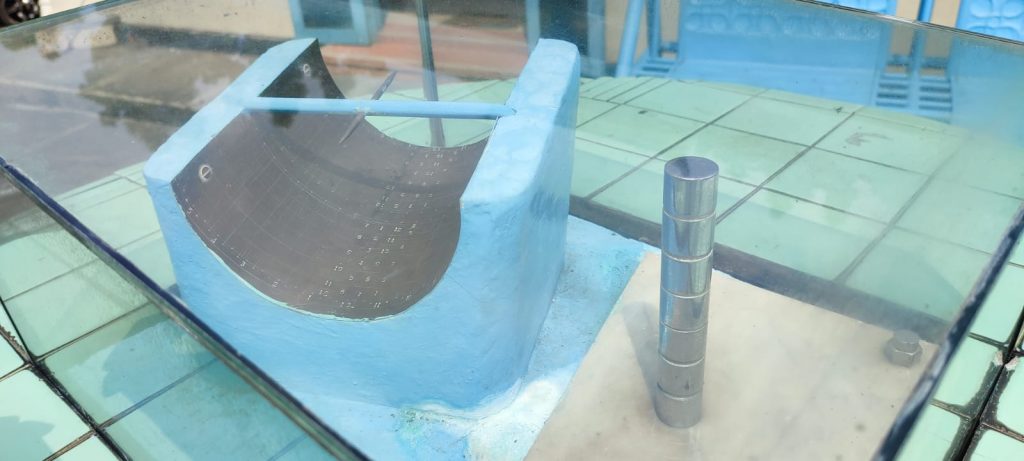
Subsequent additions were made during the Pakubuwono X era, where Pakubuwono erected a minaret to the north of the mosque and a sundial to the west to determine prayer times.
The “Istiwa” clock or clock that uses the parallel shadow of the sun as a time indicator is located in the southern courtyard of the Surakarta Grand Mosque Complex which is commonly known as the Bent Clock. This Bencet clock is in the form of a semicircular basin made of copper, and in the basin, there are lines accompanied by the numbers 1 to 12. Equipped with a needle (pandom) which is positioned horizontally pointing from north to south, the shadows from the needle have a falling direction. and means a certain time.
To the north of the mosque, there is also a settlement called Kampung Gedang Selirang. The naming of Gedang Selirang refers to the shape of the roof of the building in the architectural style of Gedhang Selirang (a hand of Banana), namely the shape of the roof that has one side of the slope. This housing was built as the residential of the mosque administrators.
Until now, the Great Mosque of Surakarta is still the center of Islamic tradition in the Surakarta Palace. This mosque is still a place for holding various rituals related to religion, such as Sekaten, whose peak event is Grebeg Mulud every 12 Rabiul Awal, Grebeg Pasa every 1 Shawwal, and Great Grebeg every 10 Dzulhijjah.